Historica Team

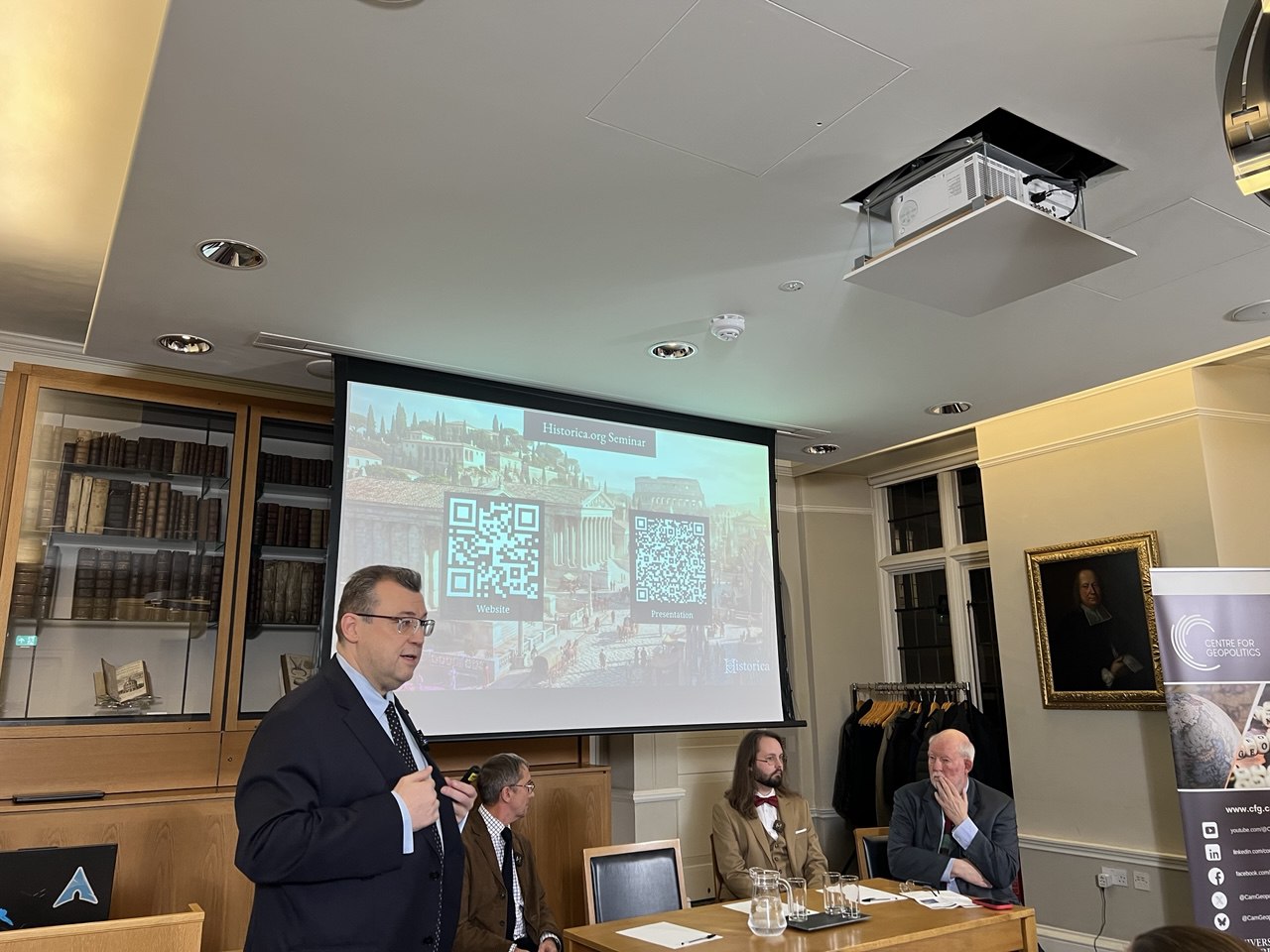
The Historica Team Presented AI-Powered Historical Mapping at the University of Cambridge

On 2 December, the Historica team took part in an academic seminar at the University of Cambridge, presenting the project’s vision and technological approach to modeling human history through artificial intelligence.

During the seminar, the team demonstrated an AI-assisted interactive map illustrating the evolution of state borders from the 11th century CE to the present day and outlined the methodology used in the construction and verification of historical maps.

As part of the event, the Rt Hon Charles Clarke, Strand-Leader for the Baltic Programme at the Centre for Geopolitics, participated in a discussion with the Historica leadership team—Dr. Alexander Tsikhilov, Project Director, Fedor Ragin, Member of the Board, Strategist, and Mr Nikita Balabanov, AI Specialist and Chief Technology Officer of the Historica.org project—addressing the broader implications of AI for historical research and geopolitical analysis.

Watch the video from the seminar here:

Don't miss out on the latest news!
Thank you! Your submission has been received!
Oops! Something went wrong while submitting the form.

People also read

Historica Team

The Historica Team Presented AI-Powered Historical Mapping at the University of Cambridge

Historica participated in an academic seminar at the University of Cambridge, presenting its AI-powered approach to modelling historical processes and mapping the evolution of state borders from the 11th century to the present.

December 4, 2025
2
min read
News
ai-generated-map

April 2025. New Technological Milestones in Historical Mapping

In April 2025, our team introduced a new method for historical mapping—based on historian logic, not image generation. It uses place data, clustering, and AI verification for more control and accuracy.

April 25, 2025
5
min read
News

Detailed Look at Historica’s Latest Technological Advancements

Discover how Historica is leveraging AI, deep learning, and machine learning to enhance historical cartography. Learn about our latest advancements in mapping historical territories, overcoming linguistic challenges, and improving visualization tools for researchers and historians.

March 4, 2025
4
min read
News

Contribute to Historica's blog!

Learn guidelines, requirements, and join our history-loving community.

Become an author

FAQs

How can I contribute to or collaborate with the Historica project?
If you're interested in contributing to or collaborating with Historica, you can use the contact form on the Historica website to express your interest and detail how you would like to be involved. The Historica team will then be able to guide you through the process.
What role does Historica play in the promotion of culture?
Historica acts as a platform for promoting cultural objects and events by local communities. It presents these in great detail, from previously inaccessible perspectives, and in fresh contexts.
How does Historica support educational endeavors?
Historica serves as a powerful tool for research and education. It can be used in school curricula, scientific projects, educational software development, and the organization of educational events.
What benefits does Historica offer to local cultural entities and events?
Historica provides a global platform for local communities and cultural events to display their cultural artifacts and historical events. It offers detailed presentations from unique perspectives and in fresh contexts.
Can you give a brief overview of Historica?
Historica is an initiative that uses artificial intelligence to build a digital map of human history. It combines different data types to portray the progression of civilization from its inception to the present day.
What is the meaning of Historica's principles?
The principles of Historica represent its methodological, organizational, and technological foundations: Methodological principle of interdisciplinarity: This principle involves integrating knowledge from various fields to provide a comprehensive and scientifically grounded view of history. Organizational principle of decentralization: This principle encourages open collaboration from a global community, allowing everyone to contribute to the digital depiction of human history. Technological principle of reliance on AI: This principle focuses on extensively using AI to handle large data sets, reconcile different scientific domains, and continuously enrich the historical model.
Who are the intended users of Historica?
Historica is beneficial to a diverse range of users. In academia, it's valuable for educators, students, and policymakers. Culturally, it aids workers in museums, heritage conservation, tourism, and cultural event organization. For recreational purposes, it serves gamers, history enthusiasts, authors, and participants in historical reenactments.
How does Historica use artificial intelligence?
Historica uses AI to process and manage vast amounts of data from various scientific fields. This technology allows for the constant addition of new facts to the historical model and aids in resolving disagreements and contradictions in interpretation across different scientific fields.
Can anyone participate in the Historica project?
Yes, Historica encourages wide-ranging collaboration. Scholars, researchers, AI specialists, bloggers and all history enthusiasts are all welcome to contribute to the project.