Before the Present Becomes History: How AI Can Help Future Generations Understand Our Time
Artificial intelligence is increasingly used to study the past. It transcribes manuscripts, searches archives, identifies people and places in historical records, and reveals connections across collections too large for researchers to examine manually.
Yet AI could also serve history in another direction. Instead of using it only to reconstruct what has already happened, we could use it to document the present while the people who lived through it are still alive, its circumstances can still be understood, and its records can still be explained.
Our time will eventually become history. The question is whether future generations will inherit enough reliable and intelligible evidence to understand it.
More information does not mean better history
Our period produces an unprecedented quantity of material. Messages, emails, photographs, videos, social media posts, location data, online publications, and institutional databases record daily life in exceptional detail.
This may suggest that future historians will know more about us than we know about previous generations. The opposite may also be true.
Digital records are often scattered across private devices and commercial platforms. Photographs remain unidentified, recordings are left without transcripts, and messages are separated from the events to which they refer. Online accounts disappear, file formats become obsolete, and companies remove services together with the content stored on them.
Even when the material survives, its meaning may not. A photograph may remain accessible while the identities of the people in it are forgotten. A message may be preserved without the political or social circumstances that made it significant. Thousands of files may exist without any indication of which ones document an important event.
The problem facing future historians may therefore be not a lack of information, but an abundance of information that is difficult to interpret.
Organizing the present as historical evidence
Most people do not deliberately create archives. They accumulate digital material without arranging it as evidence of their lives or their time.
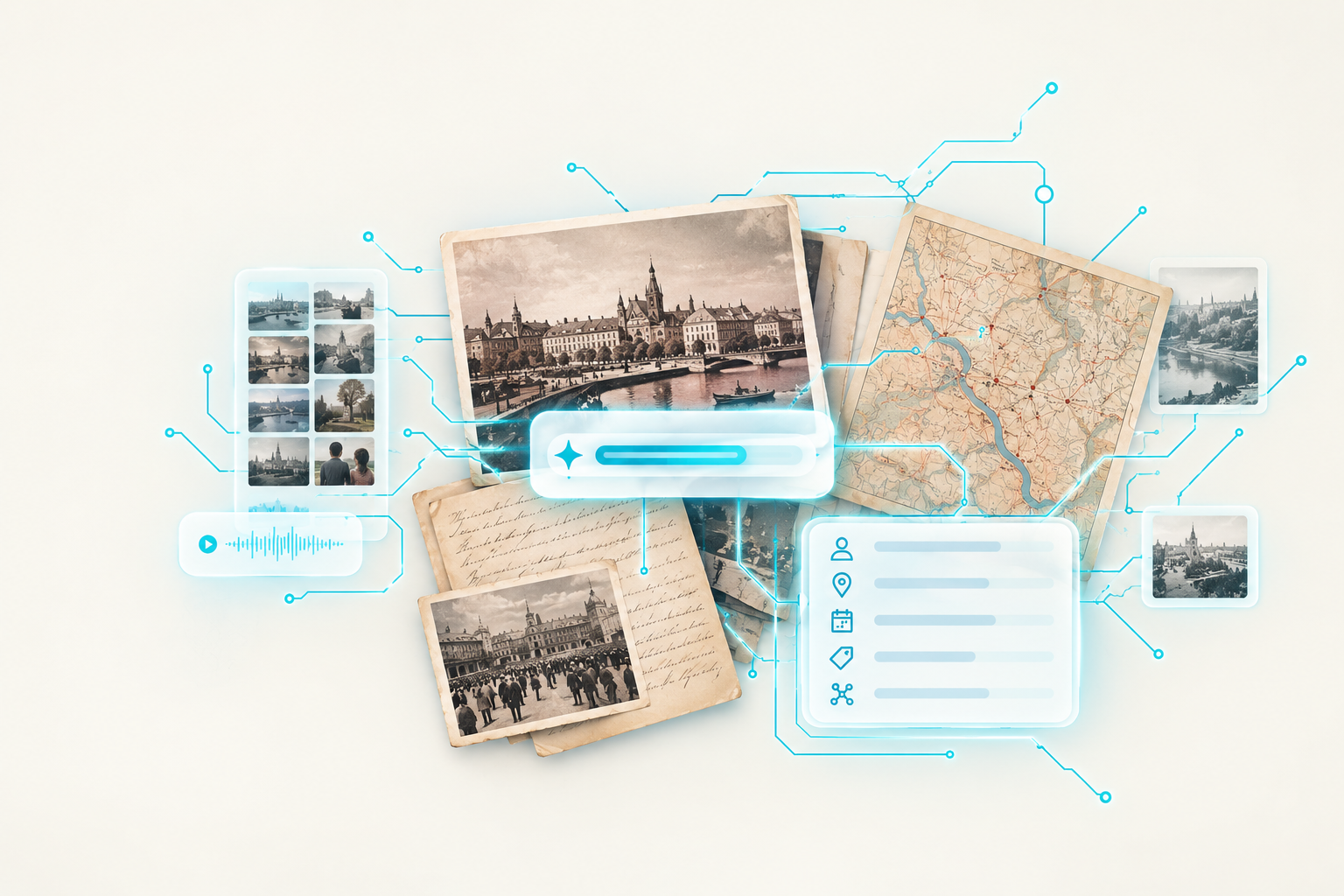
AI could help change this by identifying dates, places, people, institutions, and recurring subjects across large collections. It could connect photographs with related messages, documents, and recordings; build timelines; transcribe audiovisual material; and make personal or institutional collections searchable.
Archives are already experimenting with similar tools. AI is being tested for the automated generation of descriptive metadata, the extraction of names and subjects, and semantic search capable of finding records through meaning rather than exact keywords.
Applied while records are still being created, these methods could do more than simplify later archival work. They could reveal what is missing while there is still time to recover it. If a collection contains photographs of an event but no explanation of what happened, the system could prompt the person responsible to provide that information. If a recorded testimony mentions an unidentified person or institution, it could ask the speaker to clarify the reference.
In this role, AI would not write history in advance. It would help us leave behind material from which history could later be written more accurately.
Giving everyday life a place in the historical record
The surviving evidence of earlier periods is uneven. Governments, institutions, prominent individuals, and literate social groups generally left more extensive records than workers, migrants, rural communities, minorities, and families without the resources to preserve private collections.
Digital technology has made documentation easier, but it has not automatically corrected this imbalance. People may create large amounts of content without preserving it in a form that will remain accessible or historically useful.
AI could lower some of the practical barriers. Speech-recognition systems can turn spoken memories into searchable text. Translation tools can make testimonies available in more than one language. Image-recognition systems can assist in describing family and community photographs. Conversational tools can guide people through recording memories about education, work, migration, family life, local customs, political events, and social change.
Such material would allow future historians to study more than official decisions and public events. It could show how those events entered private life.
A factory closure, for example, may be thoroughly recorded in company documents, government statistics, and newspaper reports. Those sources can establish when the closure occurred and how many jobs were lost. They may not show how families changed their plans, why some workers left the town while others remained, which local businesses disappeared, or how the community understood the event years later.
Systematically collected personal testimony could preserve these dimensions of the present before they vanish.
Preserving context, not only content
The most serious gaps in the historical record are not always missing documents. Sometimes the document survives, but the knowledge required to understand it does not.
People rarely explain what appears obvious to their contemporaries. Private correspondence refers to events without naming them. Political statements depend on circumstances that later readers may not recognize. Humor, slang, dialect, and local references lose their meaning as language changes. Photographs preserve a scene but not necessarily its significance.
AI could help capture this surrounding knowledge while it is still available. When people upload photographs, letters, or recordings, a system could ask who created them, why they were preserved, which event they relate to, and how participants understood that event at the time.
It could also connect personal accounts with public records and invite several participants to describe the same occurrence. Their testimonies would not necessarily agree, nor should they be forced into agreement. Contradictory memories may reveal differences in experience, access to information, social position, or later interpretation.
A more useful historical record would preserve those differences instead of producing one artificially consistent account. AI could organize the testimonies and make their relationships visible without deciding which perspective should become the final version of the event.
This would not prevent every future misinterpretation. No generation can control how later historians will understand it. It would, however, reduce the number of conclusions based on missing context, unidentified records, or the preservation of only one perspective.
Conversational archives of living people
One possible application would be the creation of conversational archives based on living people.
A person could gradually record memories, answer questions, explain decisions, upload photographs and documents, and correct inaccurate information. AI could organize this material into an interactive collection through which later users could explore the person’s testimony in dialogue form.
Unlike a digital reconstruction produced after someone’s death from incomplete public sources, such a system would be created with the individual’s active participation. Its purpose would not be to imitate consciousness or suggest that the person remained digitally alive. It would provide access to a structured autobiographical record created while the person was still able to verify and expand it.
These conversational archives could be developed for public figures and witnesses to major events, but also for people whose knowledge rarely enters official collections: teachers, workers, engineers, farmers, healthcare workers, immigrants, local journalists, and members of small communities.
The value of such systems would lie in the testimony they preserve, not in the realism of the simulation.
A broader record, not an authorized history
AI cannot determine what future generations should think about us. Nor can it produce a neutral and complete record of the present.
Every archive involves selection. AI systems can reproduce existing biases, overlook material that does not fit familiar categories, distort speech during transcription, or remove ambiguity when producing summaries. If their output is accepted without review, they may create new errors while attempting to correct old gaps.
Their proper role is therefore to assist in collecting, organizing, connecting, and describing evidence, not to establish its final meaning.
People and communities must remain involved in deciding what should be recorded and how their experiences should be represented. Archivists and historians must distinguish between original material, personal testimony, automated description, and later interpretation. Differences between sources must remain visible.
The goal is not to leave future generations a finished history of our time. It is to leave them a richer body of evidence from which they can study it.
Before we become the past
Future historians will not meet us. They will encounter the records that survive us.
If those records consist primarily of official documents, public statements, and disconnected digital traces, much of contemporary life may remain invisible or be reconstructed without the context necessary to understand it. If we begin documenting the present more deliberately, future generations may inherit a broader account of how people lived, what they experienced, and how they understood the events around them.
AI gives us tools to organize material that would otherwise remain scattered, preserve testimony that might never be written down, connect private experience with public events, and identify missing information while it can still be supplied.
Its contribution to history may therefore begin long before historians open an archive. It may begin now, by helping the people of the present leave a clearer and more complete account for those who will one day study our time as the past.